

Your Pelvic Floor – After Childbirth
During our pregnancies, we are told about the importance of maintaining a strong pelvic floor, before, during and in particular after childbirth. If you have two or more children and neglected your pelvic floor after childbirth, (because you were looking after your baby and getting much needed rest by the way!), you may well be suffering from out of control bladder and/or bowel resulting in some or all of the following: urinary incontinence, urinary urgency/frequency, stool and gas incontinence, pelvic organ prolapse (or the dropping of your organs through your vagina), sexual dysfunction or pelvic girdle pain. It is a charming list of symptoms of a weak pelvic floor, varying in seriousness, those which need medical intervention, and those which are thankfully still treatable in a non-invasive way.
The anatomy of a weak pelvic floor in mothers after childbirth
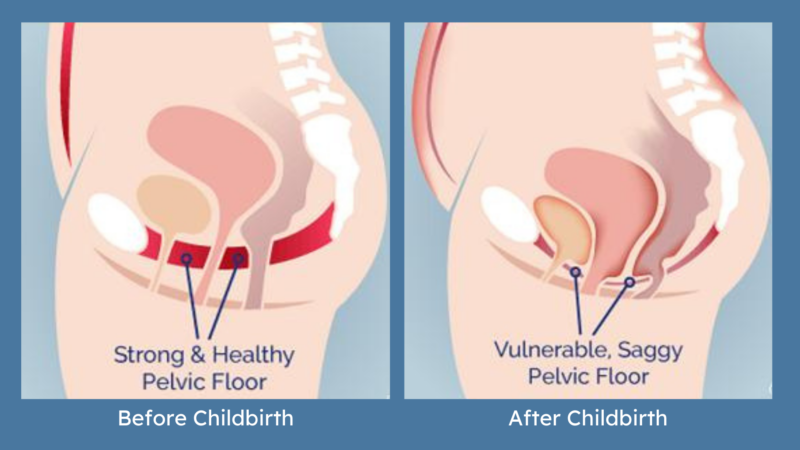
To help understand what happens after childbirth (and to varying degrees, depending on the person, everyone is different), the diagram below shows a weak ‘vulnerable’ pelvic floor muscle dropping and allowing the urinary and anal tract to be closer exposed to the exit, hence the most common of all weak pelvic floor symptoms, that of incontinence. The muscles in your pelvic floor become stretched during pregnancy and birth with weakness and occasionally damage to the pelvic floor muscles.
What happens to the pelvic floor as I get older?
The bad news continues sadly, along with all muscles in the body, these weaken as we get older, there is no exception to the pelvic floor muscles. These will weaken naturally if you are not taking any measures to strengthen your pelvic floor. Are you running to the toilet, can’t get the keys in the door quick enough? Do you use pads for exercising, or indeed everyday life, to prevent embarrassing bladder leakages? On the one hand, you may need to treat a symptom of your weak pelvic floor such as incontinence, but it is also really important to consider what a weak pelvic floor could lead to in the future.

Can a weak pelvic floor lead to pelvic organ prolapse?
A pelvic organ prolapse occurs when one or more of the pelvic organs drop into or out of the vagina, as a result of weakened muscles and tissues supporting the pelvic organs (the uterus, bladder, or rectum). Many women are embarrassed to talk to their doctor about their symptoms, but pelvic organ prolapse is treatable in a variety of ways depending on the severity of the problem. For mild to moderate cases, a pessary (in a variety of sizes) can be inserted to treat prolapse and incontinence. Pelvic floor therapy is also recommended to strengthen the muscles, this can take the form of exercises, but also the use of electrical stimulation of the muscles by a machine such as the Emsella Chair.
The pelvic floor plays a big part in maintaining our bladder and anal health as well as core strength, but did you know that a healthy pelvic floor is also important when it comes to sex?
We mustn’t neglect to talk about sex! The ability to effectively contract and relax the pelvic floor muscles helps us to facilitate and enjoy sex, reducing any vaginal pain there may be following childbirth, helping to increase vaginal lubrication and optimising the blood flow during sex to promote orgasm.
Unfortunately, for many women a lack of interest in sex is often down to pelvic floor related problems. A subject we don’t feel comfortable talking to the doctor about, but crucial to happy relationships across the Globe, it is vital to recognise that the problems being experienced during sex can be addressed and treated, leading to a happier and healthier sex life!
Is it too late to strengthen the pelvic floor?
Does menopause mean it’s too late to fix your pelvic floor health? No! While pelvic floor dysfunction can be more common around the time of menopause, the good news is you can still strengthen your pelvic floor and relieve some of your symptoms during and after menopause. If you didn’t get into the habit of doing your exercises during pregnancy, don’t beat yourself up, the challenges of being a mother are intense enough without the added pressure of kegel exercises! You can still benefit from exercising your pelvic floor if you start today!
No time for kegel exercises!

Kegels involve the tension and release of your deep pelvic muscles, and often incorporated into Pilates classes as a great way to strengthen the pelvic floor, and your core muscle region for body stability. Chances are you are still busy being a mother, juggling a work and family balance, and struggling to find time and energy to dedicate to your pelvic floor exercises! Until the problem becomes more severe, interfering with your everyday life, it is commonly an activity that is not deemed to be important in the everyday scheme of life, work, and family, and so we are back to dealing with increasingly weakening of the pelvic floor, incontinence or worse!
Help is still at hand!
Your pelvic floor therapy can begin and end over a 3 week period of non-invasive treatments that involve sitting on a chair and reading a magazine! We mentioned briefly earlier about electrical muscle stimulation of the pelvic floor muscles as part of the therapy, well the Emsella Chair is a revolutionary pelvic floor muscle strengthening treatment system. The Emsella uses High-Intensity Focused Electromagnetic (HIFEM) technology to stimulate deep pelvic floor muscles with electrical stimulation and restore neuromuscular control. One 28 minute Emsella session brings thousands of supramaximal pelvic floor muscle contractions, the equivalent of 11,000 kegels! Repetition through a further 5 treatments re-educates the pelvic floor muscles resulting in a 75% success rate after 6 treatments. Over the last decade, the technology has improved bringing about a more satisfying experience for the client, but also resulting in more women and men being cured of incontinence, and other symptoms of a weak pelvic floor.
Treatment for a weakened pelvic floor at The Springwell Clinic

New to the clinic, the Emsella Chair is the ideal choice for busy women looking for a fast and effective treatment to strengthen the pelvic floor muscles and reducing their symptoms for a more satisfying life. Come and visit us for a free consultation, no vaginal probing necessary! We will talk about your medical and childbirth history, and the problems you are experiencing to ensure the Emsella Chair is the right treatment for you. We are dedicated to providing the right treatment, and everyone is different!
Arrange a consultation with one of our practitioners today!
The Emsella Chair – Strengthening Pelvic Floor Treatment at the Springwell Clinic, Marlow, Buckinghamshire.